
The Quiet Revolution in Content Governance

The Quiet Revolution in Content Governance

When the European Union’s Digital Services Act came into full effect in early 2024, the public conversation focused on obvious targets: hate speech, terrorist content, and the obligations of massive platforms like Meta and X. Those matters deserve attention. But the DSA’s most significant consequences lie elsewhere—in the procedural architecture that will gradually, almost invisibly, alter what billions of people can say and see online. This is regulation by infrastructure, and its effects will not announce themselves with dramatic headlines.

Person typing on laptop in dimly lit office representing online content creation

As a regulatory framework, the DSA does not simply ban categories of speech. Instead, it redesigns the decision-making processes that determine whether speech reaches an audience. That distinction matters enormously. Direct content bans are visible, debatable, and subject to political contest. Procedural requirements—transparency reports, risk assessments, independent audits—operate at a remove from public view. They change outcomes without changing the rules themselves. Understanding this gap between formal rule and practical effect is central to understanding what the DSA will actually do.

What the DSA Actually Does

The DSA establishes a graduated system of obligations based on platform size and function. Very large online platforms—those with more than 45 million monthly active users in the EU—face the strictest requirements. These include mandatory risk assessments of systemic threats to fundamental rights, independent annual audits, and obligations to share data with researchers and authorities. Smaller platforms face lighter duties, though they must still provide transparent reporting on content moderation decisions.

Several provisions deserve particular attention for their implications on speech:

Notice-and-Action Mechanisms

Article 16 requires platforms to provide easy mechanisms for users to notify them of illegal content. This seems unobjectionable—indeed, most platforms already had reporting features. But the DSA introduces a structural incentive: platforms must process notices promptly and explain their decisions. Failure to maintain adequate notice-and-action systems exposes platforms to liability. The predictable result is that platforms will expand automated detection systems and lower their thresholds for removal, preferring to over-remove content rather than risk regulatory penalties for under-removal.

Risk Assessment and Mitigation

Articles 34 and 35 require very large platforms to assess and mitigate systemic risks, including threats to freedom of expression and civic discourse. Here the DSA does something quietly radical: it makes platforms responsible not only for what they remove, but for the secondary effects of their design choices. Recommendation algorithms, engagement metrics, and content ranking systems all become subject to regulatory scrutiny. This reframes speech governance as a matter of product design rather than editorial judgment.

European Union flag blowing in wind symbolizing EU regulatory authority

The Compliance Logic That Reshapes Speech

Regulation shapes behavior through compliance incentives. The DSA’s incentives push platforms toward two tendencies that will reshape online speech: procedural overreach and systemic risk aversion.

Procedural Overreach

When platforms face penalties for failing to remove illegal content promptly, but face no comparable penalties for removing legal content, the economic calculus is clear. Platforms will develop content moderation systems that err on the side of removal. We have already observed this pattern with other regulatory frameworks. Germany’s NetzDG law, which imposed strict takedown timelines for hate speech, led platforms to establish dedicated German-language moderation teams that sometimes removed satirical content and political commentary. The DSA expands this logic across the EU and across a broader range of content categories.

The procedural dimension compounds this effect. Platforms must document their decisions, explain their reasoning, and demonstrate compliance to auditors. This requires standardized policies—clear lines that moderators can apply consistently. But speech does not lend itself to bright-line rules. Satire, context-dependent expression, and political rhetoric resist straightforward classification. The bureaucratic pressure for consistency will push platforms toward simpler, more restrictive rules that are easier to enforce and defend.

Systemic Risk Aversion

The DSA’s risk assessment provisions create a different kind of pressure. Platforms must identify and mitigate systemic risks to public discourse, including disinformation and civic discourse. This language is genuinely ambiguous. What counts as a systemic risk to civic discourse? Who defines the boundary between vigorous political debate and harmful manipulation? The European Commission has issued guidelines, but these leave considerable interpretive latitude.

Platforms will respond by designing their systems to minimize perceived risk. Recommendation algorithms may down-rank content that touches contested political topics. Advertising systems may refuse to serve political ads rather than navigate the DSA’s transparency requirements for political advertising. Features that enable rapid content amplification—sharing, trending topics, viral mechanics—may be redesigned to slow their effects. Each of these changes is rational from a compliance perspective. Each also narrows the space for spontaneous, unpredictable public conversation.

Who Decides What Counts as Harm

The DSA does not create a single censorship authority. Instead, it distributes interpretive power across multiple institutions. National Digital Services Coordinators, the European Commission, independent auditors, and the platforms themselves all exercise judgment about what constitutes harmful content and appropriate mitigation.

This distributed structure has advantages. No single entity can impose its political preferences across the entire EU. But it also creates accountability gaps. When a platform removes content to satisfy a perceived regulatory expectation, the affected user may have no clear avenue for appeal. When a national coordinator applies a broad definition of disinformation, the European Commission may lack the political will to intervene. The system’s complexity makes it difficult for citizens to identify where decisions are being made and challenge them.

Close-up of hands on keyboard representing digital communication and expression

The DSA does include safeguards—rights to appeal moderation decisions, obligations to provide reasons, and protections for lawful expression. These are real, and they matter. But procedural rights are most accessible to people and organizations with resources. Individual users whose posts are flagged, down-ranked, or removed will rarely possess the time or knowledge to navigate complaint mechanisms. The structural asymmetry between platforms and speakers predates the DSA, but the regulation’s complexity amplifies it.

What Comes Next

The DSA’s effects will unfold gradually. Platform policy adjustments, moderation system redesigns, and compliance infrastructure will develop over months and years. The first audit cycle for very large platforms will reveal how companies interpret their new obligations. Enforcement actions by national coordinators will establish de facto standards. European Court of Justice rulings on challenged decisions will gradually define the boundaries of the law.

Several developments warrant close watching. First, the quality and independence of the certified auditors who will evaluate platform risk assessments remains uncertain. Second, the Commission’s designation of additional platforms as “very large” will extend the DSA’s reach. Third, the interaction between the DSA and national speech laws—particularly in member states with restrictive approaches to blasphemy, historical memory, or political expression—will test whether the regulation protects speech or merely regulates its suppression.

The DSA represents a genuine attempt to impose democratic accountability on the private powers that govern online discourse. That ambition is legitimate. But the regulation’s success depends on whether its procedural mechanisms protect expression as effectively as they restrict harm. Right now, the incentives point in one direction. Without sustained attention from civil society, researchers, and engaged citizens, the DSA will reshape online speech precisely because no one is watching it happen.

Frequently Asked Questions

Does the DSA ban specific types of speech?

No. The DSA does not define new categories of prohibited speech. It requires platforms to address illegal content—content that violates existing law in EU member states—and to assess systemic risks from legal but potentially harmful content. The distinction between removing illegal content and mitigating risks from legal content is significant, and the regulation treats them differently.

Will the DSA affect users outside the European Union?

Yes, though indirectly. Platforms that operate globally typically apply similar policies across jurisdictions rather than maintaining entirely separate rule sets for different regions. Compliance measures developed for the EU market—algorithm changes, moderation practices, transparency features—will likely influence platform behavior worldwide. This Brussels Effect has been observed with privacy regulation and appears probable here as well.

Can individuals challenge content moderation decisions under the DSA?

Yes. The DSA requires platforms to provide clear reasons for moderation decisions affecting individual users and to offer internal complaint mechanisms. Users can also escalate complaints to out-of-court dispute settlement bodies. However, these mechanisms require awareness and persistence that many users lack, and the system’s effectiveness remains untested.


Why EU Regulation Moves Slower Than Anyone Wants and Faster Than Anyone Expects

There is a particular kind of frustration familiar to anyone who has watched the European Union attempt to govern technology, finance, or environmental policy. Advocates demand action, industry warns of overreach, and the institutions themselves issue communiqués about “swift progress” — all while months stretch into years. And then, quite suddenly, a directive lands with enough force to reshape an entire sector in a matter of weeks.

European institutional buildings representing EU regulatory architecture

The Architecture of Delay

The European Union’s legislative process was not designed for speed. This is not an accident or a deficiency — it is a constitutional feature. The ordinary legislative procedure, which governs most EU regulation, requires the European Commission to propose, the European Parliament to co-legislate, and the Council of the European Union to represent member state governments. Each institution has its own internal deadlines, committee structures, and political calendars.

Consider what happens before a proposal even exists. The Commission’s better regulation agenda requires impact assessments, public consultations, and inter-service consultations across directorates-general. A single regulation on artificial intelligence — the AI Act — required an impact assessment drawing on over 1,000 stakeholder responses and months of internal review before the Commission published its proposal in April 2021. The original proposal itself ran to 108 pages of recitals and articles, because EU law must anticipate implementation across 27 legal systems.

Then begins the trilogue. The Parliament and Council each negotiate their own positions — amendments, compromises, red lines — before sitting down together with the Commission to hash out a final text. Every word can become a battleground. The word “significant” in the AI Act’s definition of risk took weeks of negotiation, because it determined whether an entire category of systems would face compliance obligations.

Why Twenty-Seven Voices Move Slowly

The Council operates by consensus whenever possible, even where qualified majority voting technically applies. A single member state can slow proceedings dramatically if it perceives its national interests at stake. Ireland held up the Common Consolidated Corporate Tax Base for years. Poland has blocked energy market reforms. Hungary has delayed rule-of-law mechanisms. This is not dysfunction; it is the price of governing a union of sovereign states with different economies, legal traditions, and political pressures.

Parliamentary chamber representing EU legislative deliberation

The Velocity of Arrival

Here is the paradox. While the production of regulation is glacial, the effect of regulation, once published, can be remarkably fast. The General Data Protection Regulation took four years to negotiate and another two before it applied — six years from proposal to enforcement. Yet when GDPR became enforceable on May 25, 2018, it reshaped global data practices within months. Companies worldwide rewrote privacy policies, restructured data flows, and hired compliance officers not because they wanted to, but because the EU market is too large to abandon.

This asymmetry — slow creation, rapid impact — stems from three structural features of EU regulation that are worth examining separately.

The Brussels Effect

Anu Bradford coined the term “the Brussels Effect” to describe the EU’s regulatory power: because the single market is so large, and because it is costly to maintain different product or service standards for different regions, companies tend to adopt EU rules globally. This means that a regulation negotiated over years in Brussels can change practices in São Paulo, Seoul, and Seattle almost overnight. The speed of adoption outside the EU far exceeds the speed of negotiation within it.

Implementation Cascades

EU directives and regulations often set frameworks that require national implementation, delegated acts, and implementing acts. Each layer unfolds on its own timeline. When the Digital Services Act entered into force, platforms had only months to comply with certain obligations, but the full regulatory architecture — codes of conduct, transparency reports, enforcement guidelines — is still being built. The initial impact is swift, but the totality of regulatory effect accumulates over years, creating a persistent sense that regulation is both already here and still arriving.

Market Pre-Compliance

Perhaps the most underappreciated accelerator is voluntary pre-compliance. When the Commission announces a regulatory initiative — even at the earliest stages — markets begin adjusting. Companies hire lawyers, restructure operations, and issue policy statements. By the time a regulation is formally adopted, much of the economic landscape has already shifted in anticipation. The Digital Markets Act was formally agreed in 2022, but designated gatekeepers began compliance preparations well before the Commission finished its designation decisions. Regulation, in this sense, moves faster than legislation.

Document and pen representing regulatory drafting and implementation

The Political Economy of Speed

There is a deeper tension at work. Democratic legitimacy requires deliberation — consultation, scrutiny, amendment. Regulatory effectiveness requires timeliness — responding to problems before they mutate beyond recognition. The EU’s institutional architecture privileges the former, and for good reason: regulations that affect 450 million people across two dozen legal systems carry democratic obligations that simple speed cannot override.

Yet this creates a persistent accountability gap. When crisis strikes — a financial collapse, a pandemic, a technology scandal — citizens and policymakers alike demand immediate regulatory response. The Commission can issue communications and recommendations quickly, but binding law still requires the full legislative cycle. This gap between demand for regulation and delivery of regulation erodes trust in institutions, even when the institutions are functioning as designed.

The response has been a gradual shift toward regulatory experimentation. The Commission increasingly uses pilot programs, regulatory sandboxes, and voluntary codes to address pressing issues while formal legislation proceeds. The AI Act includes provisions for regulatory sandboxes. The European Innovation Council funds experimental approaches to governance. These mechanisms try to bridge the speed gap by allowing controlled flexibility before final rules are set.

What the Paradox Costs

The dual speed of EU regulation imposes real costs. Slow negotiation creates uncertainty. Companies cannot plan investments when they do not know the final rules. Citizens cannot assess protections when provisions remain in flux. Environmental harm accumulates while emissions trading reforms inch through trilogue.

But rapid arrival imposes costs too. When regulation finally lands, the compliance burden hits all at once. Small and medium enterprises, which lack the legal teams of multinational corporations, often find themselves scrambling. The GDPR’s first year was marked not just by transformative privacy practices but by widespread confusion, overcautious data deletion, and compliance theater that served no one’s interests.

The honest assessment is that there is no perfect speed for regulation. Governance across 27 states will always be slower than governance within one. And regulation that affects global markets will always arrive faster than local actors expect, because its reach exceeds its origin. The task for policymakers is not to eliminate this paradox but to manage its consequences — through better transition periods, clearer implementation guidance, and genuine stakeholder engagement rather than performative consultation.

Frequently Asked Questions

Why can’t the EU just regulate faster?

The EU’s legislative process involves the Commission, Parliament, and Council — each with legitimate democratic mandates. Speed requires bypassing one or more of these institutions, which would concentrate power in ways that undermine the union’s constitutional structure. The slowness is a direct consequence of democratic representation across 27 sovereign states, each with veto power or blocking minority rights in many areas.

Does the Brussels Effect mean EU regulation effectively governs the world?

Not exactly. The Brussels Effect operates selectively and depends on market size, enforcement capacity, and the regulatory preferences of other jurisdictions. EU privacy law has had enormous global influence, but EU product safety standards matter less in markets with their own strong frameworks, like the United States. The effect is powerful but uneven, and it does not substitute for international cooperation on issues like climate or taxation.

How should businesses prepare for regulations that take years to finalize?

Track the legislative process from its earliest stages — Commission roadmaps, impact assessments, and committee votes. Engage substantively during formal consultation periods rather than lobbying only at the trilogue stage. And build compliance architecture that is adaptable: modular systems that can absorb new requirements without wholesale reconstruction. The companies that struggle most are those that treat regulation as a sudden shock rather than a predictable, if slow, arrival.

Ghost Cities No More: How America’s ‘Housing First’ Zoning Reform Wave Is Finally Reaching Suburban City Halls

The Zoning Reckoning We Should Have Had Decades Ago

There’s a moment in every local government reform movement when you realize something that seemed politically impossible five years ago is now just… happening. City council members are voting for it. Planning commissions are implementing it. Suburban neighborhoods that spent generations protecting their single-family character are suddenly allowing duplexes and accessory dwelling units. We’re in that moment right now with zoning reform, and it’s worth understanding how we got here and what it actually means for your neighborhood.

Let me set the historical stage. After World War II, American municipalities adopted zoning codes that essentially froze single-family-only neighborhoods in amber. This wasn’t accidental. These were deliberate policy choices designed to concentrate wealth, exclude certain populations, and prevent the kind of dense, mixed-use development that characterized pre-war American cities. For seventy years, these codes worked exactly as intended, creating what we might call the “geography of exclusion” that shaped where people could live based on what they could afford and who they were.

The shift we’re seeing now is closer to a genuine political realignment than a mere policy adjustment. As of early 2026, seventeen states have passed some form of statewide zoning reform that limits exclusionary single-family-only zoning. That’s up from just three states in 2019. We’ve quintupled the number of states with meaningful zoning reform in roughly six years. That’s not a slow bureaucratic crawl. That’s movement.

Montana’s Experiment and What It Tells Us

Montana provides the clearest case study because its 2023 zoning reform package is widely considered the most comprehensive in the country. The state didn’t just tinker around the edges. It fundamentally restructured how local jurisdictions could restrict housing development. Within eighteen months of implementation, building permit applications in Missoula increased by 31 percent. Bozeman saw similar growth. These aren’t small cities either; these are places with real housing pressure and genuine development politics.

What’s instructive about Montana isn’t just the raw numbers. It’s what those numbers represent: developers and builders suddenly had clearer pathways to actually build things. The reduction in regulatory friction mattered. When you make it legally possible to build a duplex in a neighborhood where only single-family homes had been allowed for fifty years, permits follow. People follow. Markets respond.

This matters because it proves something reformers have been arguing for years: the housing shortage isn’t primarily about lack of desire to build or lack of capital. It’s about regulatory permission structures. The National Association of Realtors documented in 2025 that the U.S. faces a structural shortage of approximately 4 million housing units. That number has remained stubbornly persistent even as construction starts increased. Why? Because we’re still not building fast enough in the places where people actually want to live, and much of that bottleneck traces directly back to zoning restrictions that make it illegal or nearly impossible to build anything but single-family homes.

How Federal Action Changed the Calculus for City Councils

Here’s something that gets less attention than it deserves: political movements need pressure points and incentives. Federal policy created both. The Biden-era White House Housing Supply Action Plan, launched in 2022, allocated $85 million in grant incentives specifically for municipalities that reformed exclusionary zoning laws. That program has continued through federal grant mechanisms into 2025. I know what you’re thinking: $85 million sounds small compared to the total housing crisis. You’re right. But as a catalytic investment, it’s been surprisingly effective.

Why? Because city council members respond to incentives. When a suburb that’s been debating zoning reform for three years can suddenly access federal grants by passing that reform, the calculation changes. It becomes politically easier to support change because there’s federal money attached to it. That’s not corrupt; that’s how federalism actually functions when it functions well. The federal government identified a problem, created an incentive structure, and cities responded.

The effect compounds when you look at peer learning. Once Missoula passed reform and saw permit applications jump, neighboring cities paid attention. When one state goes first, others study what happened. The National Zoning Atlas state reform tracker now works as an informal knowledge base for cities and states considering their own reforms. You can literally track what other jurisdictions tried, what worked, what created political backlash, and what the actual economic impacts were. That transparency accelerates learning.

Accessory Dwelling Units: The Zoning Reform That Sneaks Into Suburbia

One specific reform deserves its own attention: accessory dwelling units, or ADUs. These are the small homes, in-law apartments, or converted garage spaces that fit on residential lots alongside primary homes. For decades, most suburban zoning codes made ADUs illegal. Now they’re becoming standard. This matters because ADUs aren’t flashy. They don’t look like dramatic urban development. A homeowner adds a small unit to their backyard and suddenly there’s more housing in a single-family neighborhood, but it barely looks different from the street.

The Urban Institute housing policy research from 2025 found something striking: cities that legalized ADUs statewide saw median rent growth slow by an average of 4.2 percentage points compared to comparable cities that didn’t. In plain language: if rents in a comparable city without ADU legalization were growing 8 percent annually, the ADU-legal city saw growth around 3.8 percent. That’s a measurable impact on affordability from a single policy change.

ADU legalization often encounters less political resistance than other zoning reforms precisely because it feels incremental. You’re not rezoning a neighborhood for apartment buildings. You’re just saying a homeowner can add a unit to their own property. Yet the aggregate effect across a city is substantial. That’s how policy change often works at the local level: through dozens of small legal permissions that add up to meaningful structural change.

The Limits of Analogy and What Comes Next

Here’s where I want to be honest about what this reform wave is and isn’t. This is genuinely significant movement on a decades-old problem. The speed of change is real. But we should be cautious about declaring victory. Zoning reform is a necessary condition for abundant housing. It’s not sufficient on its own. You also need labor, materials, financing, and continued political will. You need to actually build the homes that zoning now allows.

There’s also the honest reckoning: zoning reform works best when paired with other policies. Inclusionary zoning requirements, community land trusts, public housing investment, tenant protections. Zoning reform alone won’t solve housing affordability for the poorest Americans. What it does is remove an artificial barrier that was making the entire problem worse.

If you’re a local activist or concerned citizen watching this play out in your own city, here’s what matters right now: pay attention to what your city council is actually doing with zoning. Are they considering ADU legalization? Allowing duplexes in single-family zones? These aren’t distant policy debates. They directly shape whether your community builds more housing at different price points. Your city council is probably thinking about this in 2026 if they haven’t already. Show up. Ask questions. Understand what your local zoning code actually says. Democracy works best when people pay attention to the meetings that aren’t sexy but actually determine how neighborhoods develop.

The AI Governance Divide: How Europe’s New Rules Are Fracturing Tech Regulation Across the Atlantic

When Regulatory Timing Becomes Political Destiny

Here’s what happened in early 2025, and why it matters more than most people realize: Europe went all-in on AI governance while America hit the accelerator in the opposite direction. In August 2025, the European Union’s AI Act moved from theoretical framework into operational reality. High-risk AI systems now face actual compliance obligations, with penalties that can reach 35 million euros or 7 percent of global annual turnover, whichever number is larger. That’s not a suggestion. That’s enforcement.

Meanwhile, in January 2025, the Trump administration signed an executive order that explicitly rescinded Biden-era AI safety directives and told federal agencies to prioritize deployment speed over precautionary regulation. Same month. Different continents. Opposite vectors. And that’s when things got genuinely complicated for the companies operating on both sides of the Atlantic.

This isn’t abstract policy disagreement. This is the kind of regulatory fork in the road that forces companies to make real choices about how they build products, where they locate infrastructure, and who they answer to. Companies trying to operate globally now face something genuinely new: mutually exclusive legal requirements from the world’s two largest technology markets.

The Compliance Crisis That Nobody Planned For

OpenAI, Google DeepMind, and Meta all submitted compliance documentation to the EU AI Office during the third quarter of 2025. They did this while simultaneously lobbying the U.S. Commerce Department to resist adopting equivalent standards. Let that sink in for a moment. The same companies were essentially telling regulators on different continents: “Yes, we’ll do what you ask, but please don’t ask what the other guys asked.”

A Stanford policy brief from October 2025 ran the actual numbers on this. The researchers found that regulatory divergence between EU and U.S. frameworks is creating compliance costs estimated at 4.2 billion dollars annually for multinational AI developers. That’s real money, and not lobbying expenses or legal fees. That’s duplicate testing, parallel infrastructure, separate AI training pipelines, and different product versions for different markets.

What makes this particularly interesting is that it’s not just Europe versus America anymore. China’s Cyberspace Administration finalized its second round of generative AI regulations in mid-2025. We now have three separate regulatory regimes operating simultaneously. The OECD recently described this as “the most consequential splintering of technology governance norms since GDPR.” When international bodies start using that kind of language, you know we’re in genuinely new territory.

You can read the EU AI Act official text and implementation timeline and see exactly what these companies are contending with. The regulatory detail is substantial. And it’s being applied right now, not at some theoretical future date.

Why This Matters Beyond Tech Industry Boardrooms

This regulatory divide isn’t just a corporate headache. It shapes what kinds of AI systems actually get built, which innovations move forward, and which get shelved. If a company has to choose between implementing robust transparency requirements or maximizing speed-to-market, and those goals conflict depending on which regulations apply, the choices they make ripple outward. They affect what products consumers see, what data gets collected, and how those systems make decisions that affect real people.

The regulatory fragmentation also creates perverse incentives. Companies with the resources to maintain separate product lines and compliance infrastructure can navigate this maze. Startups and smaller players get squeezed. This isn’t necessarily Europe’s or America’s intention, but it’s the practical result when regulatory frameworks diverge this sharply and this quickly.

There’s also something historically significant happening here beyond any single policy disagreement. For decades, American tech regulation set the global baseline. If Silicon Valley did it, the world watched. GDPR broke that pattern in 2018. Now we’re seeing multiple regulatory powers simultaneously establishing fundamentally different requirements for the same technology, operating in the same global market.

The Democratic Questions Hiding Inside the Technical Debate

Here’s where my civics teacher energy kicks in: this situation raises real questions about how democracies should think about technology governance. The European approach assumes that precaution, transparency, and public interest protection should come before deployment speed. The American approach assumes that innovation velocity and market competition drive better outcomes than regulatory frameworks. China’s approach prioritizes state oversight and content control.

All three of those philosophical positions have internal coherence. People can reasonably disagree about which one works better. But what we’re seeing isn’t a debate between these positions. Companies are navigating this by reading between the lines of different regulatory texts and trying not to violate either one. That’s not democracy in action. That’s bureaucratic compliance theater.

The Stanford HAI AI Index and policy briefs offer serious analysis of how this fragmentation is actually playing out in practice. Worth reading not because it gives you easy answers, but because it gives you actual evidence about what’s happening on the ground.

What Comes Next Depends on What We Do Now

The EU AI Act is now operational. The Trump administration has charted a deliberately different course. China is building its own regulatory architecture. These aren’t theoretical possibilities. These are the regulatory facts on the ground as 2026 unfolds.

What happens next depends partly on corporate strategy and international diplomacy, sure. But it also depends on whether citizens in these different markets actually understand what’s being decided and push back when necessary. Most people don’t follow AI governance news. That’s reasonable. Most of us are busy. But the regulatory structure that gets locked in now shapes technology for the next decade. That’s worth paying attention to.

Want to dig deeper into how this actually works? Read the regulatory documents themselves rather than summaries of summaries. Track which companies are lobbying which agencies. Notice when different regulatory bodies move on the same technology in opposite directions. This is the kind of governance question that affects all of us, even if it doesn’t make headlines as often as it should. What regulatory approach do you think actually serves the public interest better? And more importantly, what evidence would actually change your mind?

Friedrich Merz’s First 100 Days: What Germany’s Shift Means for Your Town

When a Nation Votes, Your Neighborhood Watches

Here’s what happened on February 23, 2025, and why you should care even if you don’t live in Germany: Friedrich Merz’s CDU/CSU won the federal election with about 28.5 percent of the vote—their strongest performance in over a decade. That’s not nothing. When a major European center-right party regains that kind of mandate after years of fragmentation, it sends ripples through every democratic capital on the continent. More importantly, it shows something instructive about how voters respond when they feel their government isn’t delivering on the basics: security, economic stability, and a sense that someone’s actually paying attention.

The real story, though, isn’t just about Merz or even Germany. It’s about what happens when coalition politics forces a government to make hard choices fast. The CDU/CSU didn’t win outright. The AfD finished second with roughly 20.8 percent, their highest result ever. That’s a genuine alarm bell, the kind that pushes traditional parties toward either paralysis or decisive action. Merz chose action. By April 2025, he’d sealed a grand coalition with the SPD, producing a 328-seat governing majority in the Bundestag. That kind of political clarity either works beautifully or falls apart spectacularly. His first hundred days tell us which path he’s on.

Infrastructure, Defense, and the Courage to Break Your Own Rules

One decision Merz made early will echo across European governance for years: he suspended Germany’s constitutional debt brake. This isn’t bureaucratic housekeeping. Germany’s debt brake, written into the constitution in 2009, is basically the country’s promise to itself that it won’t spend money it doesn’t have. It’s treated almost like holy law. Merz, a fiscal conservative by temperament, chose to break it anyway. Why? To fund a €500 billion infrastructure and defense package passed in March 2025. You can read the details of Merz government’s €500 billion spending package — Deutsche Welle.

This matters locally because infrastructure spending isn’t abstract. It means your city’s transit system might finally get that upgrade it’s needed. It means local contractors bid on projects. It means tax revenue eventually flows back to municipal budgets. But it also means something harder to quantify: a government decided the old playbook didn’t fit the moment. Germany faces real pressures, including industrial competitiveness against China, energy transition costs, and an eastern border that’s become active again. Merz looked at all that and said: we’re borrowing. That’s a governing instinct worth understanding, whatever your politics.

The defense side is even more telling. Germany’s Bundeswehr budget is now on track to reach three percent of GDP by 2027, exceeding NATO’s two percent benchmark. For context: Germany spent years as the alliance’s reluctant military player, the country whose historical memory made rearmament genuinely uncomfortable. Merz is essentially saying that chapter has closed. When traditional political opponents both vote for defense spending at that scale, it stops being compromise. It’s consensus.

What Consensus Looks Like When Everyone’s Worried

The CDU/CSU-SPD coalition is what Europeans call a “grand coalition,” where the two largest parties govern together, usually because they face a common threat serious enough to override normal partisan instinct. It happened in Germany in 2013, and now again. Merz is a conservative. His natural opponents are social democrats. Yet here they are, moving infrastructure and defense spending through parliament on the same legislative calendar.

What makes this relevant to how your own town or region governs is this: it shows what happens when elected leaders decide the ordinary disagreements have to wait. In your city council or county board, this might look like both parties suddenly agreeing that the water system needs serious investment, or that public safety requires real resources. The disagreements don’t disappear. They just get deprioritized. When national governments model that behavior, local governments notice and often follow. Some problems are too urgent for the usual political theater.

The AfD Factor: What Happens When You Don’t Have Consensus

The elephant in every room discussing Merz’s government is the one he won’t sit with: the AfD’s 20.8 percent result. The AfD has been shut out by every other major party—no coalition partner will govern with them. This creates a strange dynamic where the second-largest party has zero governing responsibility. They can oppose everything without owning anything. Meanwhile, Merz has to govern knowing roughly one in five voters chose a party the political establishment rejected.

This is what happens when traditional parties lose the ability to address voter anxiety. The AfD didn’t surge because their policies are compelling. They grew because millions of Germans felt unheard on immigration, energy costs, and industrial decline. Merz can pass all the infrastructure bills he wants, but if those concerns don’t translate into visible improvements in people’s daily lives, wages, housing costs, job security, the pressure that fueled the AfD’s rise doesn’t go away. It waits. This is why coalition governance matters: it forces parties to actually deliver rather than just oppose.

Your Neighborhood in a Shifting Europe

What Merz’s first hundred days reveal is a European center trying to reorient itself quickly. Suspending the debt brake signals that governments are abandoning austerity incrementalism. The defense spending trajectory signals that Europe is taking its own security seriously, not just deferring to Washington. The grand coalition itself signals that mainstream parties can still find common ground when the stakes demand it.

For your town, your city, your region: pay attention to how your own local leaders respond to these signals. Are they suddenly more interested in infrastructure? Are they talking about security and resilience differently? Are they finding reasons to work across party lines that didn’t exist before? These aren’t random shifts. They’re responses to what they’re watching in capitals like Berlin. Democratic change moves both upward and downward. The elections that matter most to your life probably happen closer to home, but they’re never really isolated from what’s happening nationally. Germany’s 2025 election results — Federal Returning Officer show a country making deliberate choices under pressure. What choices is your own government making in response?

Germany’s New Direction: How the Merz Coalition Signals a Fundamental Shift in European Security

The February Earthquake and What It Tells Us

Germany held snap elections on February 23, 2025, and the results landed like a political seismic event across Europe. Friedrich Merz’s CDU/CSU alliance secured roughly 28.5 percent of the vote, making it the largest single force in the Bundestag but still far from a majority. A decisive win by German standards, yet it arrived alongside genuinely alarming news: the AfD finished second with approximately 20.8 percent, its strongest-ever federal result. When one-fifth of German voters support a party that mainstream parties refuse to work with, you’re watching a genuine realignment. The Social Democrats, who governed through the Scholz era, collapsed to around 16.4 percent—their worst federal showing since 1945. Let that settle for a moment. The party that rose from the ashes of postwar Germany, that anchored the social market economy, now sits in third place. You can verify these figures through the Federal Returning Officer Official Results.

Germany's New Direction: How the Merz Coalition Signals a Fundamental Shift in European Security
Germany’s New Direction: How the Merz Coalition Signals a Fundamental Shift in European Security

What makes this outcome historically instructive is that it echoes, without perfectly replicating, the Weimar fragmentation of the 1930s. Then as now, economic anxiety and security concerns fractured centrist support. But here’s where the analogy reaches its limits: this is 2025 Germany, embedded in NATO, the EU, and decades of democratic institutional maturity. The AfD’s rise reflects genuine disaffection rather than fascism’s seizure of historical necessity. Still, the psychological effect cuts deep. German elites who spent seventy years building consensus around European integration now face a domestic opposition movement at one-fifth strength. That changes the baseline assumptions for any government negotiating what comes next.

The Coalition Arithmetic and What Merz Actually Needs

Coalition formation in Germany is never simple arithmetic—it’s political architecture. Merz needed partners to cross the 50-percent threshold. The Greens and SPD were the obvious choices, though the SPD’s weakness meant less leverage for social democratic priorities. The FDP represented another potential partner. The negotiating positions revealed fault lines quickly. The SPD wanted to protect social spending and climate commitments. The Greens demanded ecological safeguards. The FDP insisted on tax discipline and business-friendly policies. Merz, meanwhile, had a singular fixation: defense spending. This wasn’t mere political theater. The war in Ukraine, Russian aggression, and questions about American strategic commitment under the Trump administration created genuine pressure on Berlin. Germany had long been comfortable with its postwar role as an economic power that outsourced security concerns. That era visibly ended in February 2022 when Putin invaded Ukraine. By 2025, it was simply undeniable that Germany needed to become something it hadn’t been since 1945: a major military power.

The European Council on Foreign Relations Germany Analysis captured the strategic tension well: Germany was being asked to simultaneously manage AfD opposition, negotiate coalition complexity, and fundamentally reorient its defense posture. These aren’t usually simultaneous challenges. The fact that they arrived together explains why the February election felt less like a normal German political cycle and more like a civilizational turning point.

Breaking the NATO 2 Percent Ceiling

This is where Merz’s victory gained real geopolitical weight. The NATO target had long been 2 percent of GDP devoted to defense. Germany had grudgingly moved toward that figure under American pressure, reaching it only recently. Merz, however, signaled support for pushing toward 3 percent, an enormous shift representing roughly 100 billion euros in additional annual spending. To put that in perspective: it’s equivalent to Germany’s entire federal education budget. To accomplish it, he needed to overcome three obstacles at once: Green party skepticism about military spending, FDP dogmatism about the constitutional debt brake, and a broader German cultural resistance to rearmament that runs deep.

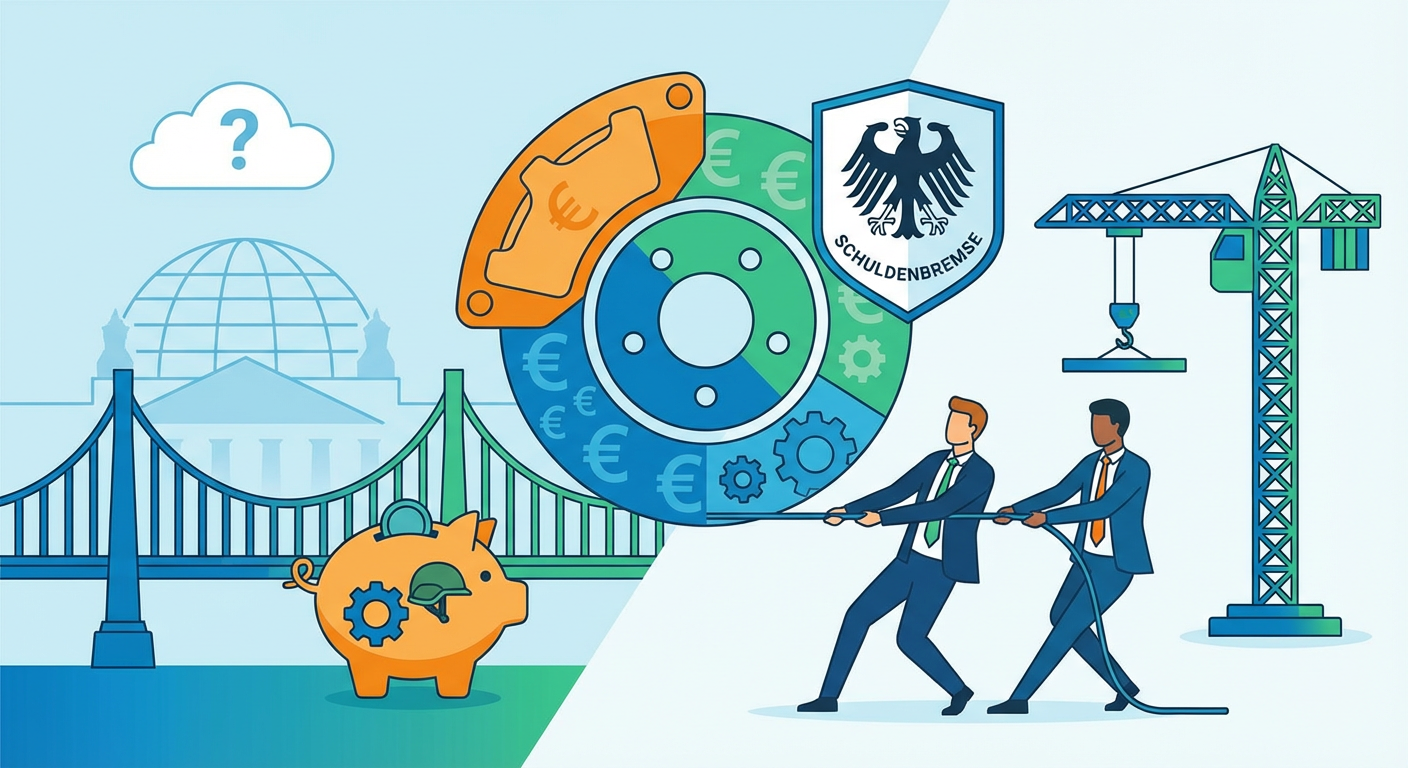
The debt brake deserves explanation because it matters for understanding how constrained German politics actually is. Enshrined in the constitution in 2009, the Schuldenbremse limits federal borrowing to 0.35 percent of GDP in normal years. It’s Germany’s answer to fiscal responsibility, forged after reunification spending ran wild in the 1990s. But a constitutional debt brake becomes a cage when you’re trying to finance generational military transformation. Merz’s government immediately identified this as the battleground. Defense and infrastructure spending of 100 billion euros-plus required either massive tax increases, massive spending cuts elsewhere, or constitutional amendment. Each option carried political costs. This wasn’t abstract economic policy. This was the mechanism through which German democracy would actually decide whether to become a serious military power or maintain its postwar identity.

Historical Parallels and Their Proper Limits

German history offers useful but dangerous lessons. The 1960s saw similar defense spending debates as the country rearmed within NATO. Back then, the Soviet threat was externally obvious and NATO membership was politically straightforward. Today’s debates occur in a landscape where a significant minority supports Russian positions, where American commitment seems uncertain, and where China’s rise adds non-European dimensions to security planning. The historical parallel that matters most might actually be the 1950s, when Germany transitioned from occupied nation to sovereign state within a Western alliance. That transition required psychological reorientation, institutional creativity, and sustained political consensus-building. Merz faces similar challenges, though the European context is stronger now and the democratic baseline higher.

What distinguishes 2025 from earlier postwar moments is that Germany’s rearmament occurs alongside genuine internal political fracture. The AfD’s one-fifth strength means roughly one German voter in five will view military spending through a geopolitical lens fundamentally at odds with NATO integration. That’s manageable but real. Historical Germany twice failed to manage such internal divisions while maintaining democratic stability. This generation of Germans knows that history intimately. That knowledge is both constraint and potential strength.

What This Means for European Security Architecture

The Merz government didn’t simply represent a CDU victory. It represented a structural reconceptualization of Germany’s role in European security. For decades, European security architecture rested on American military dominance, British-French nuclear deterrence, and German economic power married to political restraint. That architecture frayed visibly after 2022. Russia’s Ukraine invasion showed that American commitment couldn’t be assumed. Trump’s presidency raised questions about NATO’s future. The EU needed to get more militarily serious. Germany, as Europe’s largest economy and most populous nation, couldn’t avoid the central role. Merz understood this. His campaign made it explicit. The February results gave him a mandate, if not a command.

The Merz coalition essentially committed Germany to becoming a permanent 3-percent defense spender, investing in long-range missiles, expanding army capacity, and integrating more deeply into NATO command structures. This is the most significant German military expansion since the Cold War. For Europeans, it creates both opportunity and anxiety. Opportunity because a serious German military capability could reduce European dependence on American commitment. Anxiety because German rearmament has historically carried complicated meanings. The Merz government navigated this by framing defense spending as European solidarity and NATO commitment rather than German national assertion. That framing is politically necessary and probably sustainable, but it requires constant maintenance.

Living With Democratic Complexity

The real lesson from Germany’s February election isn’t that one outcome proved optimal or inevitable. It’s that democracy produced this specific configuration of pressures and responses. The CDU won decisively without commanding majorities. The AfD rose substantially without gaining power. Coalition partners negotiated competing visions into operational policy. No philosopher-kings decided German security architecture in a seminar. Instead, millions of Germans voted according to their interests and convictions, and their distributed choices produced this government. That’s messier than autocracy. It’s also more resilient.

What happened between February’s election and the actual formation of Merz’s government tells us whether German institutions can manage the competing demands of military transformation, coalition compromise, and internal political polarization. That story continues to unfold. If you’re tracking how European security evolves, how democracies adapt to genuine threats, or how historically cautious nations reimagine themselves, Germany in 2025 deserves close attention. The stakes involve not just German futures but European ones. What aspects of this transformation concern you most, or seem most overlooked in the coverage you’re seeing?

Syria After Assad: Six Months of Pragmatism, Uncertainty, and the Great Power Shuffle

When Autocracy Crumbles: The December Breakthrough and What It Actually Means

On December 8, 2024, forces led by Hayat Tahrir al-Sham swept into Damascus and did something that seemed politically impossible just months earlier: they ended Bashar al-Assad’s 24-year grip on power. Assad fled to Moscow, where Russia granted him asylum, bringing a brutal dynasty to an abrupt end. This wasn’t a slow transition negotiated in conference rooms. It was a rapid collapse, the kind of sudden shift that catches even seasoned analysts off-guard and raises immediate questions about what comes next.

Historical thinking is genuinely useful here. If you’ve studied major regime changes, you know the pattern: a government falls quickly, euphoria fills the streets, and then the real work begins. Think East Germany in 1989 or the Philippines in 1986. The military hardware and security apparatus don’t vanish overnight. Neither do the geopolitical interests of neighboring powers and distant superpowers. Understanding Syria’s post-Assad moment requires holding two truths at once: yes, something genuinely historic happened, and yes, the hardest part is just beginning.

The HTS Gamble: Transitional Authority and the Sanctions Question

Ahmed al-Sharaa, formerly known by his militant nom de guerre Abu Mohammad al-Jolani, was named head of Syria’s transitional governing body in January 2025. That name change is instructive. It signals a calculated break from his organization’s history and a deliberate repositioning as something other than a jihadist militia. He’s pledged inclusive governance, promised protections for minorities, and outlined a path toward pluralism. These aren’t small claims in a country fractured by thirteen years of civil war.

But here’s the catch: as of early 2026, al-Sharaa remains on the UN Security Council sanctions list, still technically designated a terrorist entity by multiple countries. The United States suspended the $10 million bounty on his head in January 2025 and has engaged in direct diplomatic contacts, but formal sanctions relief remains partial and cautious. This awkward halfway state reflects the real dilemma facing the international community: do you engage pragmatically with a leader whose organization emerged from the Syrian branch of al-Qaeda, or do you maintain principled distance? The Biden and now Trump administrations have chosen engagement, betting that a stabilized Syria matters more than consistency on terrorism designations.

As Carnegie Middle East Center: Syria’s Post-Assad Transition noted, this represents a fundamental recalibration of how Western capitals approach transitional governments. It’s messy, it offends purists on both left and right, but it’s the substance of actual diplomacy rather than doctrine.

Turkey’s Playbook: Speed, Economics, and Strategic Partnership

While Washington deliberated, Turkey moved. Ankara had backed key rebel factions throughout Syria’s conflict and saw immediately that the new Damascus administration presented both opportunity and risk. By March 2025, Turkey had signed a preliminary cooperation framework with the transitional authorities, moving quickly to expand economic and security partnerships. This wasn’t tentative diplomacy. This was a regional power working the opportunities while they were fresh.

Turkey’s approach offers a useful historical lesson. When you’ve invested years and resources into a conflict, you don’t sit back and wait for others to set the terms in the aftermath. Ankara has clear interests: preventing Kurdish autonomous consolidation along its border, securing trade routes, and establishing itself as the primary external security anchor for Damascus. By moving fast with economic agreements and military cooperation frameworks, Turkey made itself indispensable before other powers could establish competing relationships.

The Turkish model parallels what larger powers do in their own neighborhoods. Russia didn’t wait for international consensus before establishing its influence in post-Soviet states. China doesn’t hesitate to expand Belt and Road initiatives into emerging markets. Regional powers understand that transitional moments reward speed and clarity of purpose. Turkey’s playbook has been exactly that: be present, be useful, be essential.

The Displacement Crisis: Where Humanitarian Reality Meets Political Optimism

Now let’s talk about what matters most: the actual lives of Syrians. According to the UN Office for the Coordination of Humanitarian Affairs, approximately 7.2 million Syrians remained internally displaced as of mid-2025. That’s roughly one-third of the pre-war population still unable to safely return home. The transitional government projected rapid refugee returns from Turkey and Lebanon, but reality has moved slower. Many refugees remain skeptical about safety guarantees. Returnees face destroyed homes, disputed property claims, and communities still fractured along sectarian and political lines.

This gap between governmental optimism and humanitarian reality is worth sitting with. The HTS-led administration has strong incentive to declare stability and announce victories. International donors want to believe in progress. But millions of displaced Syrians are more cautious. UN OCHA: Syria Humanitarian Situation Reports 2025 tracks these numbers rigorously, and they tell a story of uneven recovery. Some neighborhoods have seen return flows, while others remain ghost towns. Sectarian tensions haven’t vanished. Economic collapse is ongoing.

The Geopolitical Poker Game: Who Wins, Who Loses, and What We’re Actually Watching

Step back and look at the bigger picture. Russia maintains military bases and significant leverage. Turkey is positioning as the principal external power. The United States is engaging diplomatically while maintaining some sanctions and strategic ambiguity. Iran’s influence has collapsed but its proxy networks haven’t entirely dissolved. Israel is conducting strikes against suspected militants and weapons transfers. European nations are calibrating humanitarian assistance with strategic hedging.

This isn’t a straightforward story where the good guys win and go home. It’s a complex competition where multiple powers are simultaneously trying to shape outcomes, and none of them can simply impose their will. The transitional government has genuine agency but operates within constraints set by external interests. Syrian actors have to navigate between these powers while attempting to build functional institutions from the wreckage of a state.

After six months, the report card reads something like this: the Assad system has genuinely fallen. A transitional authority exists and is attempting reforms. The refugee situation remains dire but hasn’t worsened catastrophically. Regional powers are engaged rather than in direct conflict. Economic recovery hasn’t begun in earnest. Democratic institutions are nascent and vulnerable. The threat of renewed fragmentation persists. It’s neither triumph nor disaster. It’s the messy middle ground where most political transitions actually live.

The Question Before Us: What Happens When the Transition Stops Transitioning?

Here’s what fascinates me about this moment: Syria’s transitional government faces a deadline that nobody’s explicitly discussing. Transitions are called that because they’re supposed to be temporary. At some point, provisional authority becomes actual governance, or the whole structure collapses back into conflict. The HTS-led administration will need to deliver tangible improvements in daily life, demonstrate inclusive governance rather than just promise it, and convince skeptical communities that this break from Assad’s brutality is real and durable. All of this while managing great power interests and a displaced population measured in millions.

That’s the real test ahead. Not the geopolitical maneuvering, though that matters. Not the sanctions designations, though those shape opportunity. The test is whether institutions can be built quickly enough to prevent a return to chaos, whether power can be shared rather than hoarded, and whether Syrians themselves believe the new system is worth defending.

Germany’s February Election: How the Center-Right Surge and Far-Right Second Place Are Reshaping Europe’s Political Center of Gravity

The Results That Surprised Almost No One (Except Everyone)

Let me start with what actually happened on February 23, 2025, because the numbers matter more than the narratives being spun around them. Friedrich Merz’s CDU/CSU coalition won approximately 28.5% of the vote, making them the clear largest party in the Bundestag. That’s not a landslide by historical standards, but it’s decisive enough. Meanwhile, the AfD placed second with roughly 20.8%, the strongest far-right federal result in post-war German history. And then there’s the genuinely historic collapse: Olaf Scholz’s SPD crashed to around 16.4%, its worst federal performance in over a century.

Germany's February Election: How the Center-Right Surge and Far-Right Second Place Are Reshaping Europe's Political Center of Gravity
Germany’s February Election: How the Center-Right Surge and Far-Right Second Place Are Reshaping Europe’s Political Center of Gravity

I know what you’re thinking: didn’t everyone see this coming? The short answer is yes, the polling was remarkably consistent. But there’s a difference between watching a forecast and watching it arrive. When a major democracy’s center-left governing party gets cut roughly in half, and the far-right nearly reaches one-fifth of seats, that’s not just a normal election cycle. It’s a recalibration of what “normal” even means in German politics.

The deeper story isn’t about surprise. It’s about what happens when you actually count the votes and have to govern.

Coalition Talks, Firewalls, and the Math That Doesn’t Lie

Here’s where things get genuinely complicated, and where American readers especially should pay attention. After the results came in, Germany’s mainstream parties faced a structural problem: no two traditional coalition partners had enough seats together. The Greens performed modestly. The FDP didn’t clear the 5% threshold. The Left Party was fractured. Which meant Merz’s CDU/CSU, despite winning the largest share, had to negotiate across a fractured middle.

But there was another constraint that shaped everything. All mainstream parties maintained a “firewall” policy against working with the AfD. This wasn’t just ideology, though ideology matters. It was a deliberate democratic choice to exclude a party that had become the gravitational center of anti-immigrant, anti-EU, and proto-authoritarian messaging. Coalition negotiations stretched over several weeks precisely because mainstream parties had to find mathematically viable combinations without crossing that line.

This took real time. Germany’s government formation process revealed something worth sitting with: formal democracy means you actually have to negotiate. You can’t just declare a winner and move on. When the largest party can’t simply govern alone, and when there’s a democratic consensus to exclude a significant vote-share from formal power, you get messier but sometimes more durable outcomes.

The European Implications: Fragmentation at Exactly the Wrong Moment

Now let’s talk about why this matters beyond Germany’s borders. The EU isn’t a federation, but it functions through constant coordination among member states. Germany, as Europe’s largest economy and a geopolitical anchor, plays an outsize role in that coordination. And in 2025, Europe faces genuinely complex budget negotiations scheduled for 2025-2026.

The Bertelsmann Stiftung published analysis in early 2025 warning specifically about this dynamic. German political fragmentation, they documented, would complicate EU budget talks at a moment when the Union needed decisiveness. You can read their detailed analysis in their Bertelsmann Stiftung EU Policy Analysis. The research doesn’t present a doomsday scenario, but it’s clear-eyed about the friction points.

A weakened German center-left means less traditional support for EU social harmonization and migration-focused initiatives. A surging far-right, even from opposition, pulls the entire conversation rightward. A center-right government under Merz has different EU priorities than Scholz had, and different coalition partners within Germany means those priorities aren’t locked in stone. Brussels and other European capitals were watching these negotiations closely because they understood: German coalition dynamics directly shape European policy bandwidth.

What This Means for the Center-Right Across Europe

Let’s zoom back out. Germany’s CDU/CSU result didn’t happen in isolation. Center-right parties across Europe have been developing a particular political identity: fiscally cautious, skeptical of EU centralization, attentive to immigration concerns, but still fundamentally pro-NATO and pro-democratic institutions. Merz’s win, and the specific coalition partners he eventually negotiated with, will shape how this European center-right bloc develops over the next several years.

This is different from the left-right axis you might learn in a high school civics class. It’s about how mainstream conservative parties position themselves relative to both the progressive left and the populist right. Germany’s election results suggested that roughly 49% of voters still wanted mainstream parties (CDU/CSU plus SPD plus Greens). That’s not nothing. It means democratic institutions retained legitimacy even as they faced pressure.

But that 20.8% for the AfD isn’t going anywhere. It’s a real constituency with real grievances, even if some of those grievances are being mobilized by demagogues. A center-right government that ignores why those voters moved rightward will find that support consolidating further.

Checking the Evidence and Asking Better Questions

If you want to verify any of this yourself, the Federal Returning Officer Official 2025 Election Results provide the authoritative data. Not polls. Not analysis. The actual numbers. I’d encourage you to look at them directly, because one of the most important skills in democratic citizenship is learning to distinguish between what the data says and what various political actors claim it means.

Germany’s February 2025 election matters for Europe because it shows how democracies actually function when they’re under pressure. Coalitions form through negotiation, not decree. Mainstream parties can still command majorities even when the far-right surges. But that majority is harder to build, requires more compromise, and leaves less room for bold action. Whether that’s a feature or a bug depends partly on what you think Europe needs right now.

The real story isn’t about any single party’s rise or fall. It’s about what happens when voters across an entire continent start reshuffling their loyalties simultaneously. If you’re tracking European politics, German elections, or how democracies function under pressure, this election cycle is worth studying closely. What questions do these results raise for you about how your own country’s political center is holding?

DOGE’s First Year: When Government Efficiency Meets Reality

The Promise: A Trillion-Dollar Audit

When the Department of Government Efficiency launched in early 2025, it arrived with the kind of audacious mandate that rarely survives first contact with bureaucracy. Led by Elon Musk and co-led initially by Vivek Ramaswamy, DOGE set out to identify over one trillion dollars in potential federal savings. That number needs context. The entire federal budget hovers around six and a half trillion dollars annually. A trillion in claimed cuts represented roughly 15 percent of total spending, identified within months of the department’s creation. If accurate, it would have rewritten the fiscal conversation in Washington.

The appeal was obvious. Federal spending frustrates Americans across the political spectrum, and the idea that trillions in waste could be found by competent auditors felt genuinely refreshing to a lot of people. DOGE leaned into this narrative hard. The department published lists, issued reports, and generated headlines suggesting that government bloat was just sitting there, waiting to be trimmed by anyone willing to look closely. For a moment, the efficiency argument seemed to cut across party lines. Who doesn’t want government to waste less money?

The Scrutiny: What Actually Counts as Savings

Then the Congressional Budget Office and independent analysts took their turn. What they found was instructive, a lesson in accounting that civics teachers could use to explain why careful reading matters. Many of DOGE’s identified savings counted contracts that had already expired, funds legally obligated to specific purposes, or spending that had simply shifted rather than disappeared. The gap between trillion-dollar claims and defensible cuts widened quickly. The Congressional Budget Office Federal Budget Analysis pointed out that genuine budget reduction requires eliminating programs entirely or reducing their authorized spending levels, not just flagging theoretical inefficiencies.

This distinction matters, and it has historical roots. Similar efficiency movements have come and gone before. In the 1970s and 1980s, various administrations launched their own cost-cutting initiatives with comparable zeal and comparable gaps between ambition and outcome. Each generation seems to rediscover that government waste is easier to talk about than to actually eliminate, especially when savings require confronting entrenched interests or politically difficult choices. DOGE’s situation wasn’t unique. That didn’t make the disconnect less frustrating to watch.

The Workforce Question: Where Cuts Hit Reality

DOGE’s most concrete ambitions centered on federal employment. The Office of Personnel Management Federal Workforce Data showed approximately 2.3 million civilian federal employees as of 2024. DOGE targeted reductions of up to 75 percent in some agencies. Think about that number for a second. Three quarters of an agency’s workforce gone. The math was stark, the implications were stark, and the legal resistance was immediate.

By early 2026, over 100 federal lawsuits had challenged DOGE’s workforce reduction efforts. Courts blocked several initiatives under the Administrative Procedure Act, which requires agencies to follow specific procedural steps before making major changes. Federal judges repeatedly found that DOGE had moved too quickly, without adequate notice or opportunity for comment, or without sufficient legal basis for the claimed reductions. These weren’t always ideological rulings. They were often straightforward applications of administrative law. The government has rules even when it’s pursuing efficiency.

This has historical precedent too. The Reagan administration attempted dramatic federal workforce reductions in the 1980s. The Clinton administration pursued significant downsizing in the 1990s. Both faced legal challenges, achieved partial success, and discovered that federal employment is protected by layers of statute and regulation designed to prevent exactly the kind of rapid, unilateral action DOGE attempted. Those protections exist for reasons, whatever you think of those reasons. DOGE ran straight into them.

The Retreat: Personnel and Pressure

By mid-2025, Elon Musk stepped back from his formal DOGE role. Tesla shareholder pressure mounted. Other responsibilities called. A department that had been synonymous with one person’s outsized energy suddenly had to keep going without its primary public face. DOGE continued under new leadership, but with reduced media visibility and a noticeably quieter presence. The moment had passed. What remained was institutional rather than revolutionary.

That pivot says something important about the limits of efficiency movements built around individual personalities rather than institutional change. Musk’s involvement had created both energy and instability. The energy attracted attention and generated momentum. The instability meant everything depended on one person’s availability and enthusiasm. When he stepped away, the department lost its defining feature and had to compete for attention in a crowded news cycle alongside foreign policy crises, economic data, and electoral politics. It’s hard to sustain a revolution on a slow news week.

The Lessons: What Efficiency Actually Requires

So what did DOGE’s first year actually teach us? A few things worth sitting with. First, identifying theoretical waste is genuinely different from eliminating actual spending. A trillion dollars in claimed savings and a few hundred billion in defensible cuts are entirely different categories. Second, federal employment is protected by law in ways that make rapid reductions difficult regardless of who’s in charge. Third, efficiency efforts built around individual personalities tend to lose momentum when those personalities move on. Fourth, skepticism about government accounting isn’t partisan. It’s just prudent.

The broader historical pattern is worth considering too. Efficiency movements usually accomplish something, just not quite what their architects imagined. They expose real waste in some areas while creating new inefficiencies elsewhere. They succeed politically even when they fall short fiscally. They reshape the conversation about what government should do even when they don’t reshape government itself. DOGE will probably follow this pattern. Some programs will be reduced. Some offices will consolidate. Some waste will be cut. But the trillion-dollar vision and the 75 percent workforce reductions will stay in the aspirational column.

What’s your take on all this? Have you watched these efficiency efforts play out in your own experience with local or state government? That’s often where the real lessons are, where you can actually see who makes decisions and what gets cut and what stays. If you’ve got stories or questions about how government actually works when you look closely, I’d genuinely love to hear them. That’s where the real civics happens.

When the Referee Leaves the Game: Understanding Trump’s Tariff Escalation and the Collapse of Global Trade Rules

The System That Kept Us Honest

For nearly three decades, the World Trade Organization functioned as something like an umpire in the global economy. It wasn’t perfect. No international institution is. But it gave countries a forum to air disputes, established common rules, and most importantly, created consequences when governments broke those rules. When a nation felt cheated by another’s trade practices, there was an actual process. Evidence got examined. Decisions got made. Sometimes even enforcement happened.

I want you to understand this because what’s happening right now is a genuine structural shift in how the world economy operates. This isn’t just another political disagreement over trade policy. This is about what happens when the rule-making body itself becomes so weakened that it can’t actually enforce anything anymore.

April 2025: The Tariff Announcement and What It Means

In April 2025, the Trump administration unveiled a sweeping new tariff strategy built around the concept of “reciprocal tariffs.” Here’s what that actually looked like in practice: a baseline 10 percent tariff slapped on virtually all imports coming into the United States, with certain countries facing significantly higher rates. China got hit hardest, with tariffs climbing as high as 145 percent at peak escalation points.

To put this in concrete terms, imagine you run a small manufacturing business that depends on imported components. That 10 percent baseline doesn’t sound catastrophic until you realize it compounds across your entire supply chain. And if you source anything from China, you’re looking at tariff rates that might exceed your actual profit margin. This wasn’t incremental policy adjustment. This was a fundamental reshaping of how goods move across borders.

The stated justification centered on addressing what the administration viewed as unfair trade relationships. The mechanics, however, tell a different story about whether established international institutions still have any real authority.

The WTO’s Empty Chair Problem

Here’s where the institutional crisis becomes crucial to understanding why these tariffs matter so much. The WTO Appellate Body, the final arbiter for trade disputes, has been non-functional since 2019. It hasn’t been able to hear cases or make decisions for six years. And the reason? The United States has consistently blocked the appointment of new judges to the panel.

This created a situation where countries with legitimate complaints about each other’s trade practices literally have nowhere to take them. You can file a dispute. You can go through the lower panels. But when you need that final authoritative decision, the chair sits empty. It’s as though the Supreme Court went offline but everyone still pretended the justice system worked normally. For detailed context on how this dysfunction developed, you can review the WTO dispute settlement and Appellate Body crisis overview.

The timing matters because countries like the European Union had no option to challenge these tariffs through the system that was supposed to exist. The EU could respond with their own retaliatory measures, and in 2025 they did exactly that, implementing countermeasures on approximately 21 billion euros worth of U.S. goods. But this wasn’t judicial review. This was economic tit-for-tat. Eventually, both sides negotiated a 90-day pause, but they did so from positions of economic coercion, not legal obligation.

The Economic Consequences and the Shifting Supply Chain

When you remove the institutional constraints on unilateral tariff action, you get economic consequences that ripple far beyond the countries directly involved. The International Monetary Fund assessed the damage in their April 2025 World Economic Outlook and downgraded global growth forecasts by 0.5 percentage points, citing precisely this kind of trade policy uncertainty as a key factor. Half a percentage point might not sound dramatic until you remember we’re talking about trillions of dollars across the global economy. You can review those forecasts and the analysis at the IMF World Economic Outlook April 2025.

What’s particularly instructive is how supply chains adapted. China began rerouting its exports through alternative pathways, particularly toward ASEAN nations. Trade analysts at the Peterson Institute estimated that Chinese exports to Southeast Asia surged approximately 18 percent in the second half of 2025. Trade didn’t collapse. It just found new routes around the obstacles.

Think about what this means in practical terms. If you’re a business owner, you’re spending resources mapping new suppliers in different countries, negotiating new contracts, absorbing disruption costs. If you’re a worker, you might see your job move to a different country that doesn’t face the same tariff barriers. The tariffs were supposed to protect American manufacturing, but they created incentives that pushed investment toward third countries instead.

What Comes Next: Is the Rules-Based Order Actually Finished?

The question framing this conversation asks whether the rules-based trade order is finished. I think that’s both too binary and too pessimistic, though I understand why people ask it. The WTO is clearly weakened. The Appellate Body dysfunction is real and persistent. And yes, major trading powers are increasingly willing to act unilaterally when it serves their interests.

But here’s what I’ve learned from watching institutions at every level, from local planning boards to international organizations: they don’t usually disappear. They transform. Sometimes they become less effective. Sometimes they get circumvented. But actors who benefit from having some kind of structured dispute resolution process generally have incentives to maintain at least the appearance of rules.

What we’re actually watching is a competition between two visions of international order. One vision maintains that rules matter, that procedure matters, and that institutions referee disputes according to established law. The other says that power matters more, and that each country should act in its own perceived interest regardless of institutional constraints. These visions are fighting it out in real time, and the outcome is genuinely uncertain.

The mechanisms matter here because they determine what happens next. If the Appellate Body remains non-functional, countries will continue finding workarounds and alternative arrangements. Some might be bilateral agreements. Some might be regional trade blocs organized around shared interests rather than universal rules. The architecture gets messier. Whether it gets fundamentally broken depends on what countries choose to do in the next few years.

This is civic engagement territory, even though it looks like abstract international policy. Trade policy affects prices, employment, supply chains, and investment decisions that ripple down to your community. Track not just the tariff announcements but the institutional responses. Watch whether countries push to repair the Appellate Body. Notice whether they negotiate new dispute resolution processes outside the WTO. These mechanisms are where the real choices happen. What patterns are you seeing in how your own country’s trading partners are responding?