

The April Shock and What It Meant
When the Trump administration rolled out its sweeping tariff executive order in April 2025, it did something that hadn’t happened in nearly a century. The administration imposed a 10 percent universal baseline tariff on essentially all imports entering the United States, with China facing the sharpest blow: targeted rates that climbed to 145 percent on certain categories of goods. If that number seems almost theatrical in its extremity, remember that shock value was precisely the point. This wasn’t just a trade policy adjustment. This was a deliberate reset of how America approached its role in global commerce.

What made this moment historically significant wasn’t simply the tariff rates themselves. It was the architecture underneath them. By establishing a universal baseline rather than sector-specific protections, the administration fundamentally shifted the conversation. Previous administrations had used tariffs as scalpels, targeting specific industries or countries. This approach wielded a sledgehammer. And that difference matters enormously when we’re trying to understand what happens next in global economics.
The Historical Echo: How 1930s Protectionism Mirrors 2025
Here’s where historical context becomes genuinely useful, though we need to be careful about letting analogies run away with us. The last time American tariff rates reached comparable heights was during the Smoot-Hawley era of the early 1930s. By the third quarter of 2025, according to Peterson Institute for International Economics Trade Analysis, the effective average U.S. tariff rate had climbed to its highest level since 1934. That’s not an accident. It’s a direct historical parallel that economists are now discussing openly.
But here’s what makes the comparison tricky, and why we shouldn’t simply replay the 1930s playbook. The global economy is fundamentally different now. Trade flows involve complex supply chains that didn’t exist then. Financial markets respond in milliseconds rather than days. China isn’t a competitor on the periphery of American trade but deeply embedded in manufacturing networks across nearly every sector. The mechanics have changed, even if the underlying protectionist impulse feels familiar.
That said, the Smoot-Hawley comparison teaches us something valuable: trading partners respond to tariff escalation. They don’t simply accept it. Between May and September 2025, Canada and Mexico filed three separate arbitration cases under the USMCA dispute settlement process, specifically challenging the steel and aluminum tariffs that the administration had also imposed. These aren’t hypothetical threats. They’re formal legal challenges that signal serious intent from our closest trading partners to push back through every available mechanism.
The Global Recession That Nobody Voted For
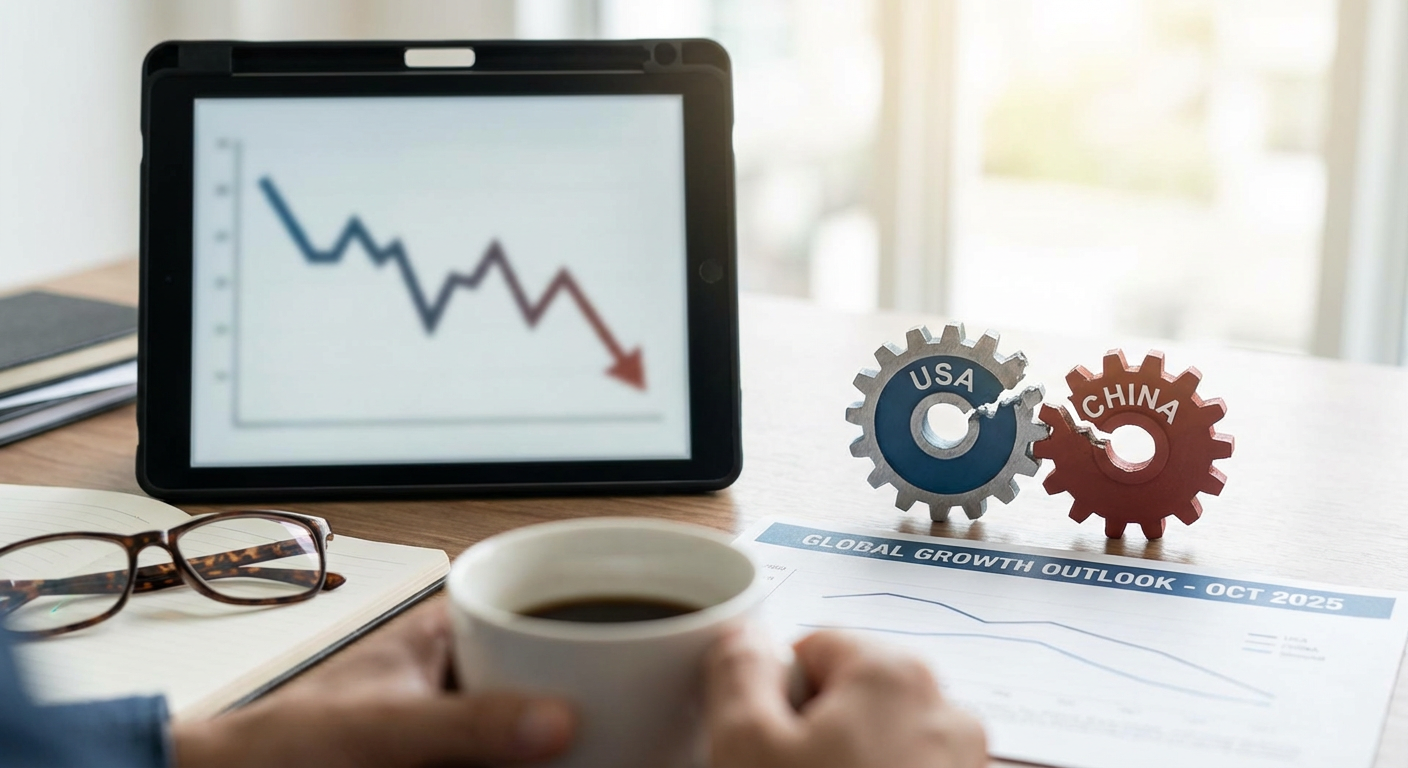
Numbers tell stories if you know how to listen to them. The International Monetary Fund revised its global growth forecast downward to 2.8 percent for 2025 in its October outlook, and when economists point to reasons, they keep coming back to one thing: U.S.-China trade fragmentation. This isn’t some abstract economic indicator. This means reduced growth. This means slower job creation globally. This means pressure on governments everywhere to either retaliate or absorb the costs internally.
The IMF World Economic Outlook October 2025 painted a picture of an interconnected world where one country’s tariff escalation becomes everybody’s growth problem. American businesses relying on imported inputs face higher costs. European exporters see their market shrink. Emerging economies dependent on U.S. demand feel the pinch almost immediately. This is how protectionism actually plays out in practice, and it rarely follows the tidy economic theory that its proponents promised.
When Allies Become Adversaries in Trade
Perhaps the most revealing moment came when the European Union activated its Anti-Coercion Instrument for the first time in mid-2025. The EU doesn’t use new weapons lightly. This was their first deployment of a tool specifically designed to counter economic coercion, and they targeted approximately 18 billion euros in American goods with retaliatory countermeasures. Think about what that represents. The institutions created to maintain the Western alliance’s economic order were now being mobilized against a founding member.
This matters because it shows how trade disputes quickly become political ones. The EU didn’t activate this instrument because they love bureaucratic escalation. They did it because they calculated that their farmers, manufacturers, and workers needed protection from what they viewed as unwarranted American aggression. When you understand trade policy through the lens of citizens and communities actually affected by tariffs, the political responses become much more comprehensible.
What We’re Learning in Real Time
We’re living through a genuine experiment in trade policy, and while experiments are supposed to teach us something, they can be expensive. The tariff structure of 2025 is reshaping how countries think about supply chain vulnerability, local manufacturing, and strategic autonomy. Some of that reshaping might prove genuinely beneficial. Certain domestic manufacturing sectors that had atrophied might rebuild. But other consequences are harder to control. Inflation pressures. Consumer costs. The erosion of trust in international institutions that took decades to build.
The historical parallel to the 1930s remains instructive precisely because it shows us that protectionism rarely achieves its stated objectives in the way its architects envision. It triggers responses. It creates unintended consequences. It forces countries into corners where they must choose between economic pain and political survival. None of that means tariffs are always wrong as a policy tool. But it does mean we should watch carefully as this unfolds, document what happens, and think seriously about what we want to optimize for: short-term protection, long-term growth, alliance management, or something else entirely.
The questions worth asking now aren’t about whether the tariffs will achieve their stated goal of bringing manufacturing back to America. The real questions are about what trade-offs we’re willing to accept, which allies we can afford to damage, and whether the benefits will outweigh the disruptions. These are questions without easy answers. They’re also the questions that engaged citizens should be paying attention to as the policy evolves. What’s your community experiencing? Which sectors in your region are affected? What are local leaders saying about their conversations with Washington? That’s where the real story lives.
Recent Comments